
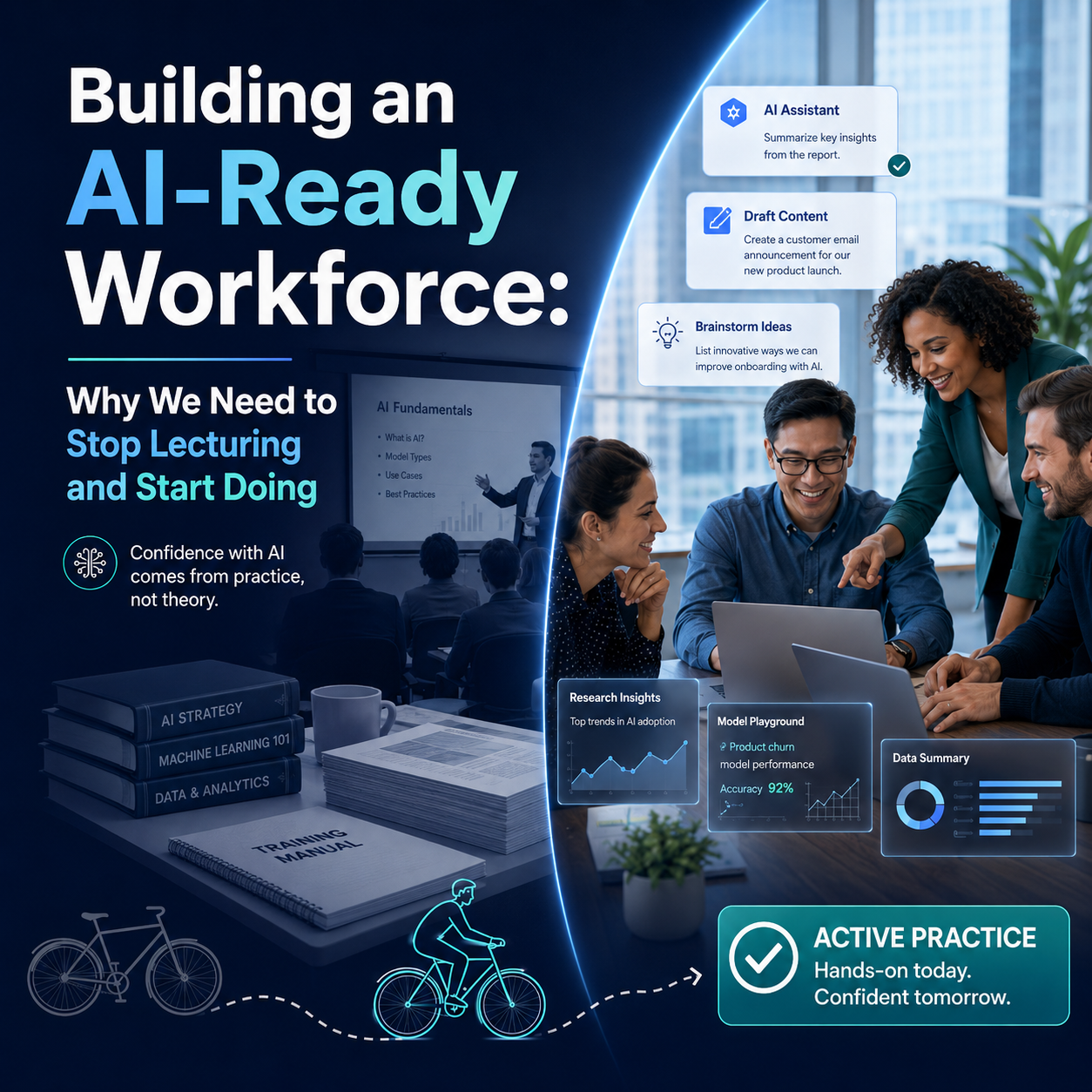
Stop Lecturing. Start Learning AI by Doing

Remember when you learned to ride a Bicycle? You didn’t read a manual about balance and pedal physics. You got on the Bicycle, wobbled, maybe scraped a knee, and eventually figured it out.
Today, many companies are trying to teach their teams about Artificial Intelligence (AI) using the “manual” approach. They sit through long webinars and read dense guides. But just like riding a Bicycle, you can’t learn AI just by reading about it. You have to do it.
For business leaders, the pressure to “adopt AI” is very real. But sending employees to a seminar on AI theory won’t make them AI-ready. True readiness doesn’t come from memorizing tech buzzwords; it comes from building confidence through practice.
It simply means giving your team the space to experiment with AI tools in their daily routines.
Instead of a lecture, give them a safe sandbox. Let them use AI to draft a tricky email, summarize a 50-page report, or brainstorm ideas for a client meeting. When they actually use the tools, they learn how they work. More importantly, they learn the tool’s quirks—what to trust, and what always needs a human double-check.
The Leader’s Playbook
If you are a C-level executive or manager, you set the culture. Here is how you can encourage hands-on learning:
- Give permission to play: Tell your team it is okay to test new tools and make mistakes. Innovation requires a little bit of messing up.
- Share your own stumbles: Talk about the time AI gave you a completely weird answer and how you fixed it. It removes the intimidation factor and humanizes the technology.
- Focus on the problem, not the tech: Ask your team, “What tedious task takes up your Friday afternoons?” Then, challenge them to explore if AI can help solve it.
Building an AI-ready workforce isn’t about turning everyone into a computer programmer. It’s about giving your people the confidence to use new tools to make their jobs easier and more meaningful.
Let’s step out of the lecture hall and get our hands dirty. The best way to learn the future is to simply start using it today.