
IT Leaders’ Top 5 Priorities for 2026: Technologist to Visionary

The digital transformation is no longer a future prospect; by 2026, we must fully embrace it. The waves of AI, data, and cyber threats are no longer on the horizon; they’re here, and they’re reshaping the landscape in real-time.
Having navigated numerous tech revolutions, this one feels fundamentally different. The role of the IT Leader is transforming from a builder of systems to a shaper of culture, strategy, and human potential. The tech itself is the easy part; the real work is integrating it wisely into the heartbeat of our organizations.
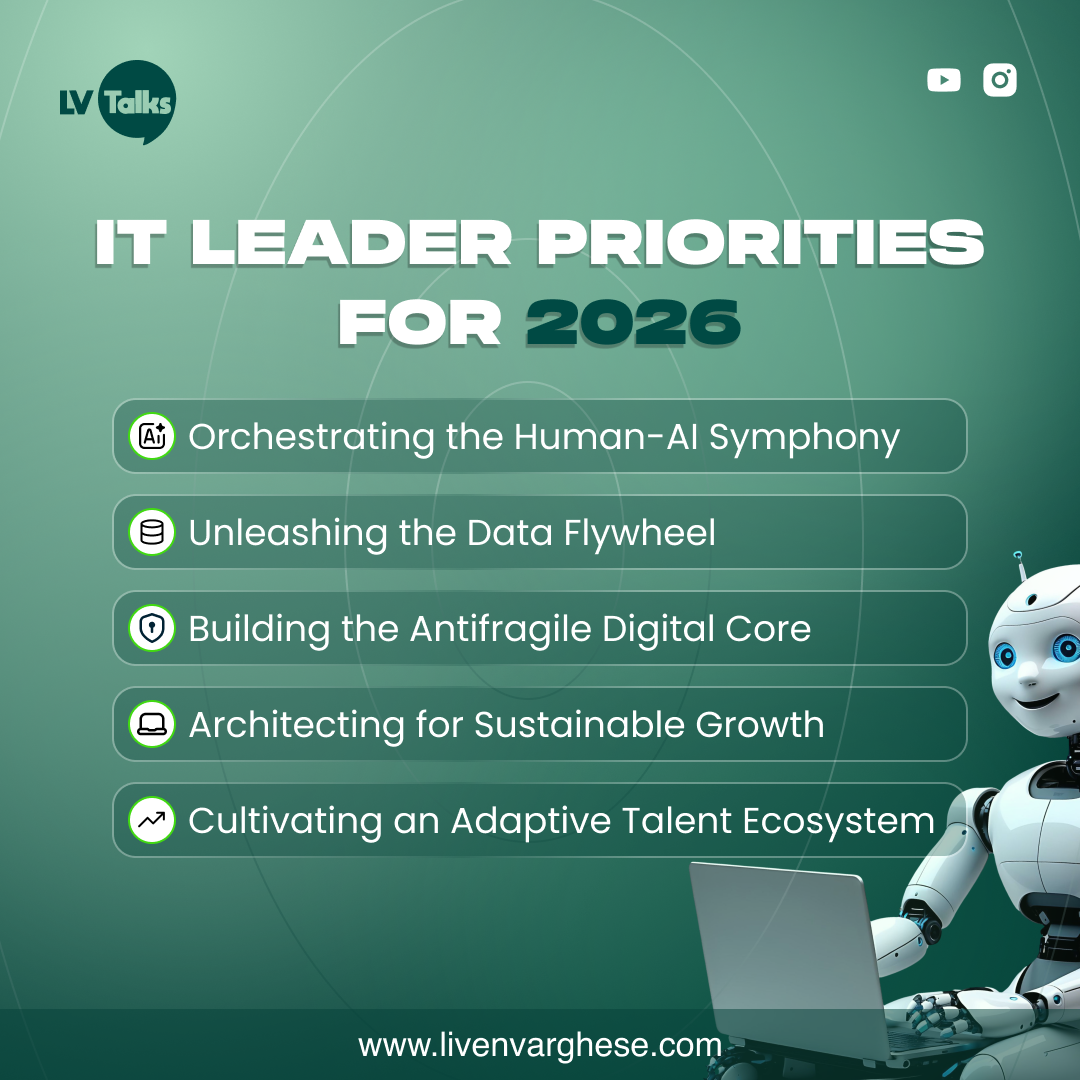
Here are the top five priorities that will shape IT leaders ’ agendas in the upcoming year:
- Orchestrating the Human-AI Symphony
- Unleashing the Data Flywheel
- Building the Antifragile Digital Core
- Cultivating an Adaptive Talent Ecosystem
- Architecting Sustainable Growth
- Orchestrating the Human-AI Symphony
In 2025, we focused on becoming “AI-native.” In 2026, the priority shifts to perfecting the orchestration between human intuition and machine intelligence. It’s not about humans versus AI; it’s about humans and AI, playing in concert. The IT Leader becomes the conductor of this symphony.
We are moving beyond simple task automation. We’re entering an era of AI as a collaborative partner. Imagine a marketing team where an AI handles real-time, multivariate campaign analysis, but the human strategist interprets the emotional nuance and crafts the overarching brand story. Think of a software developer who describes a complex function in plain English, and an AI translates it into flawless, secure code, freeing the developer to focus on architectural design. The goal is to create “super-teams” where the whole is vastly greater than the sum of its parts.
Identify key workflows where AI can augment human creativity and strategic thinking. Invest in tools that facilitate this collaboration and, most critically, foster a culture where employees are empowered to co-create with AI, not feel threatened by it.
2. Unleashing the Data Flywheel
We’ve spent years talking about data governance and mastering our data. That foundational work is now table stakes. The 2026 priority is to create a data flywheel – a virtuous cycle where data generates insights, insights drive action, and those actions generate new, valuable data, making the system smarter and more powerful with every turn.
Static data warehouses are giving way to dynamic, real-time data ecosystems. Your customer data shouldn’t just sit in a CRM; it should flow seamlessly to inform supply chain decisions, personalize marketing interactions, and guide product development. When a customer reports an issue, that data should immediately feed back into the system to improve the AI model that caused it, preventing the same issue for others. The data becomes a living, breathing asset that fuels continuous innovation.
Break down the final silos between your data sources. Invest in platforms that enable real-time data streaming and analytics. Most importantly, create feedback loops everywhere, ensuring that every interaction and outcome is captured and used to spin your data flywheel faster.
3. Building the Antifragile Digital Core
Cybersecurity can no longer be just about building stronger walls. The walls will be breached. In 2026, the priority is building systems that are “antifragile” systems that don’t just resist shocks but actually become stronger and more adaptive because of them. This is about resilience at the core of your digital DNA.
An antifragile system anticipates, responds, and learns. It uses AI not just to detect threats, but to autonomously contain and neutralize them while isolating affected areas – like an immune system for your IT infrastructure. It means having data backup and recovery systems so seamless that a ransomware attack becomes a minor operational hiccup, not an existential crisis. It’s about stress-testing your entire digital estate through continuous, simulated attacks to find weaknesses before adversaries do.
Shift your security budget from pure prevention to detection, response, and recovery capabilities. Implement AI-driven security orchestration and automate incident response. Practice your crisis drills relentlessly, because in 2026, it’s not about if you get hit, but how gracefully you recover.
4. Architecting for Sustainable Growth
The conversation around sustainability and ethics is moving from the periphery to the center of the boardroom agenda. In 2026, IT Leader’s legacy will be measured not just by profitability, but by their positive impact on the planet and society. This is about building a tech strategy that is inherently sustainable and ethically sound by design.
It’s a two-fold mandate. First, Environmental Sustainability: This means optimizing cloud workloads for energy efficiency, choosing partners based on their carbon footprint, and using AI to model and reduce your company’s entire environmental impact. Second, Ethical Governance: This involves implementing robust frameworks for responsible AI that are auditable and transparent. It means having clear answers for how you eliminate bias in your algorithms and protect consumer privacy in a world of pervasive data collection.
Mandate “Green IT” assessments for all new projects. Weave ESG (Environmental, Social, and Governance) metrics into your technology ROI calculations. Your tech stack is a statement of your company’s values.
5. Cultivating an Adaptive Talent Ecosystem
The “skills gap” is now a “skills chasm.” The half-life of technical skills is shorter than ever. In 2026, the most successful IT leaders will stop thinking of “recruitment” and start building an “adaptive talent ecosystem” – a fluid, dynamic environment for continuous learning and growth.
This goes beyond traditional upskilling. It’s about creating internal marketplaces for projects where employees can pivot to new roles and develop new skills on the job. It’s about embracing flexible work models powered by digital collaboration tools to tap into global talent pools. It’s about leadership that coaches for potential, not just manages for performance. The goal is to build an organization that is as agile and adaptable as the technology it uses.
Democratize learning. Use AI to create personalized career pathing for every employee. Foster a culture of internal mobility and “gig-based” project work. Your primary role as a leader is to be a mentor and a creator of opportunities for your people to reinvent themselves.
From Technologist to Visionary
In 2026, the IT Leader’s most valuable skill won’t be their understanding of Java or JavaScript, but their mastery of empathy, ethics, and ecosystem thinking. Our job is to build organizations that are not only technologically advanced but also resilient, responsible, and profoundly human.
The question for 2026 is no longer “What technology should we buy?” It’s “What kind of organization do we want to become, and how can technology help us get there?”