
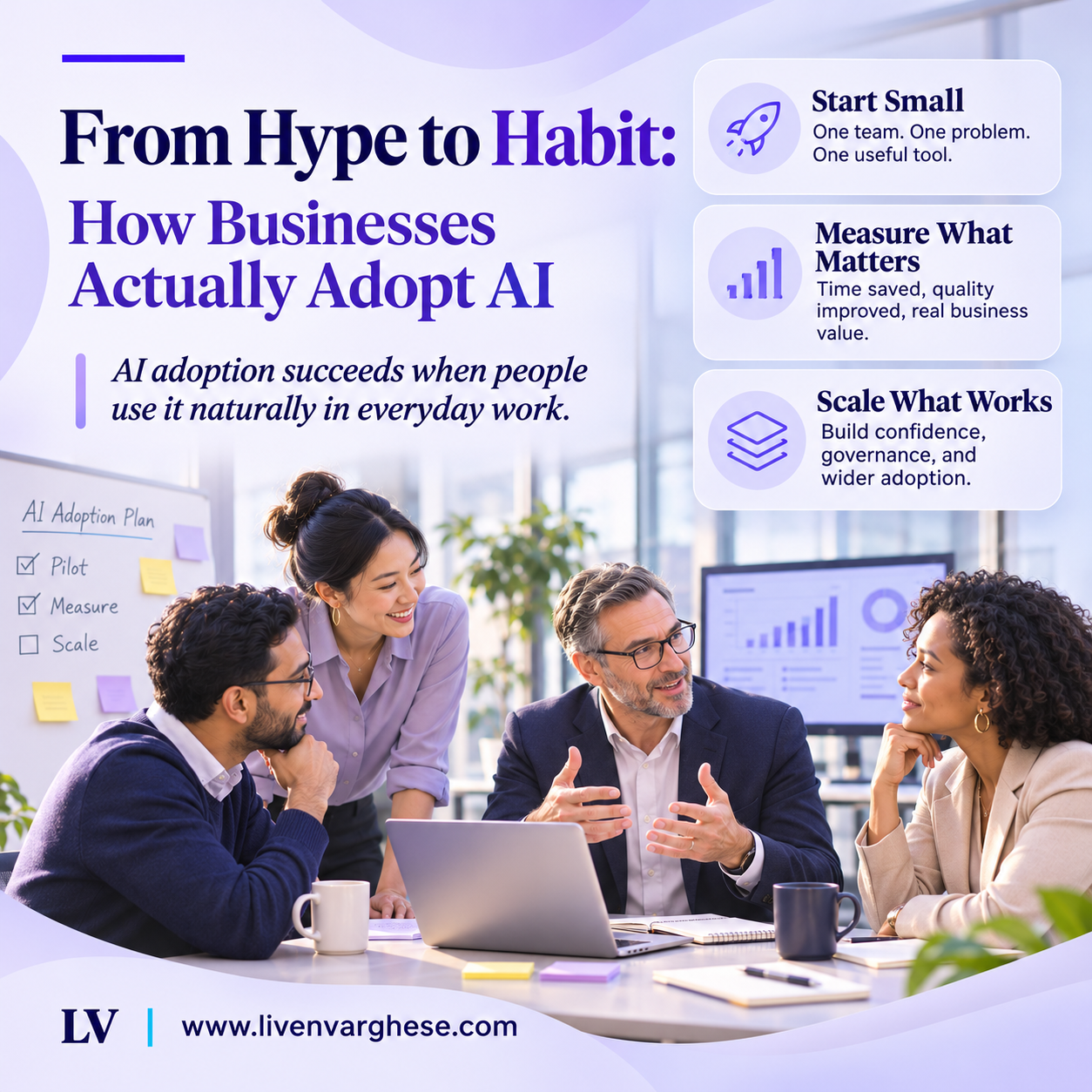
From Hype to Habit: How Businesses Actually Adopt AI

Every January, we hear a familiar statement from business leaders: “This year, we are going to focus on AI.”
There are management discussions, strategy meetings, budgets, workshops and sometimes even a dedicated AI task force. Everyone is excited about the possibilities. But a few months down the line, the excitement starts fading. There may be a few impressive demos and pilot projects, but very little has changed in the way people actually work.
Why does this happen?
Having spent years leading technology and digital transformation initiatives, I believe the biggest challenge in AI adoption is not technology, investment or even technical expertise. It is changing the way people work and making that change sustainable.
AI should not be another project on the management agenda. It should gradually become part of the organisation’s working culture.
The Problem: We Start Too Big
Many organisations approach AI as if they are preparing for a moonshot. They start with ambitious objectives, significant investments and broad statements like “We want to become an AI-driven organisation.”
There is nothing wrong with having a big vision. But the journey towards that vision doesn’t necessarily need to start with a big project.
Rather than asking, “How can we implement AI across our organisation?” I would start with a few simpler questions:
- What are the repetitive tasks our employees spend too much time on?
- Where are we experiencing unnecessary delays?
- What information is difficult for our teams to access?
- Which business processes could be made simpler?
These conversations often reveal more valuable AI opportunities than expensive technology demonstrations.
Sometimes, helping an employee save 30 minutes every day can deliver more practical business value than a sophisticated AI solution that nobody regularly uses.
A Practical Approach: Pilot → Measure → Scale
I strongly believe organisations, particularly small and medium-sized businesses, can start their AI adoption journey with a simple 90-day framework.
Days 1–30: Start Small and Keep It Simple
Pick one team, one business problem and one suitable AI tool.
It could be the marketing team using AI to prepare initial content drafts, the customer service team summarising customer enquiries, or the HR team simplifying internal documentation.
The objective is not to impress management with what AI can do. It is to make someone’s daily work a little easier.
Involve the employees who actually perform these tasks. Understand their challenges, provide basic training and give them the opportunity to experiment within clear data security and usage guidelines.
Don’t expect perfection from day one. Give people room to learn, make mistakes and improve.
A small initiative that people genuinely use is far more valuable than a large initiative that exists only in a presentation.
Days 31–60: Measure What Really Matters
Once the pilot is running, the next step is to understand whether it is creating any meaningful value.
I would not measure AI adoption simply by the number of licences purchased, prompts generated or employees attending AI training sessions.
Instead, look at practical business outcomes:
- How much time are employees saving?
- Has the quality of their work improved?
- Are we responding to customers faster?
- Has the workload on employees reduced?
- Are employees continuing to use the solution voluntarily?
It is equally important to consider the time spent reviewing AI-generated outputs, correcting errors and managing the associated risks.
If the pilot does not deliver the expected benefits, that’s perfectly fine. Understanding what doesn’t work is also a valuable outcome, especially when we discover it without making a significant investment.
Days 61–90: Scale What Works
Once a use case demonstrates measurable business value, explore how it can benefit other teams or departments.
Share the results internally. Let the employees who successfully adopted AI explain their experiences to their colleagues.
In my view, an employee explaining how AI helped reduce two hours of manual work is often more convincing than a management presentation filled with global AI success stories.
People develop confidence when they see their own colleagues succeeding with technology.
At this stage, organisations should also establish the necessary governance, security practices, ownership and continuous learning mechanisms to support wider adoption.
The objective is not just to scale the technology, but to scale the confidence and capabilities of people.
The Common Traps That Kill AI Initiatives
There are a few mistakes organisations should be conscious of during their AI journey.
Starting with the tool instead of the problem. Purchasing an AI solution and then searching for a business problem to solve is rarely a good starting point.
Ignoring frontline employees. The people performing the work every day often have a better understanding of operational challenges than those sitting in strategy meetings. Listen to them.
Celebrating the demo as a success. A successful demonstration proves that something is possible. It does not necessarily prove that it is useful, reliable or sustainable.
Looking at AI purely as a cost-cutting exercise. AI should also be seen as an opportunity to improve employee productivity, accelerate decision-making, enhance customer experience and create new business opportunities.
Expecting adoption without continuous learning. A one-day AI workshop will not transform an organisation. People need ongoing encouragement, practical exposure and opportunities to learn from each other.
AI Adoption Is as Much About People as Technology
As someone who comes from both a technology and human resource management background, I have always believed that successful transformation depends heavily on how we manage people through change.
Employees may have concerns about AI. Some may worry about their jobs, while others may simply lack the confidence to use new technology.
These are genuine concerns, and leaders need to address them through communication, training and involvement rather than simply making AI usage mandatory.
Instead of telling employees that they must use AI, show them how AI can help them do their jobs better.
When people experience the benefits themselves, adoption becomes much more natural.
Moving From Hype to Habit
The real success of AI adoption is not when an organisation announces its AI strategy, launches a new platform or completes its first pilot.
It is when employees naturally start using AI as part of their everyday work, without waiting for instructions from management.
Not every business needs to build its own AI platform. Not every process needs AI. And not every AI initiative needs a huge budget.
What every organisation needs is a clear understanding of its business challenges, a willingness to experiment, a culture of continuous learning and leadership that supports the journey.
Start small. Learn from experience. Measure the value. Build confidence. Then scale.
The future belongs not necessarily to businesses that invest the most in AI, but to those that successfully make AI a meaningful part of how their people work every day.
That is when we truly move from hype to habit.